
Virginia “Elective Share”: Why it’s Different from “Marital Property” in Divorce.
Many people assume that if an asset would be considered separate property in divorce, it is automatically protected from a surviving spouse at death. But Virginia elective share rules work very differently. In Virginia, marital property for divorce and the augmented estate for elective share purposes are not the same thing—and understanding that difference can prevent major estate planning mistakes.
Virginia uses very different rules for:
Marital Property in Divorce
and
Elective Share After Death
Those two systems may involve some of the same assets, but they answer very different questions.
Understanding that difference matters—because many people unintentionally create estate plans based on divorce rules, only to discover that death follows an entirely different framework.
So for this week in our ABCs of Estate Planning series:
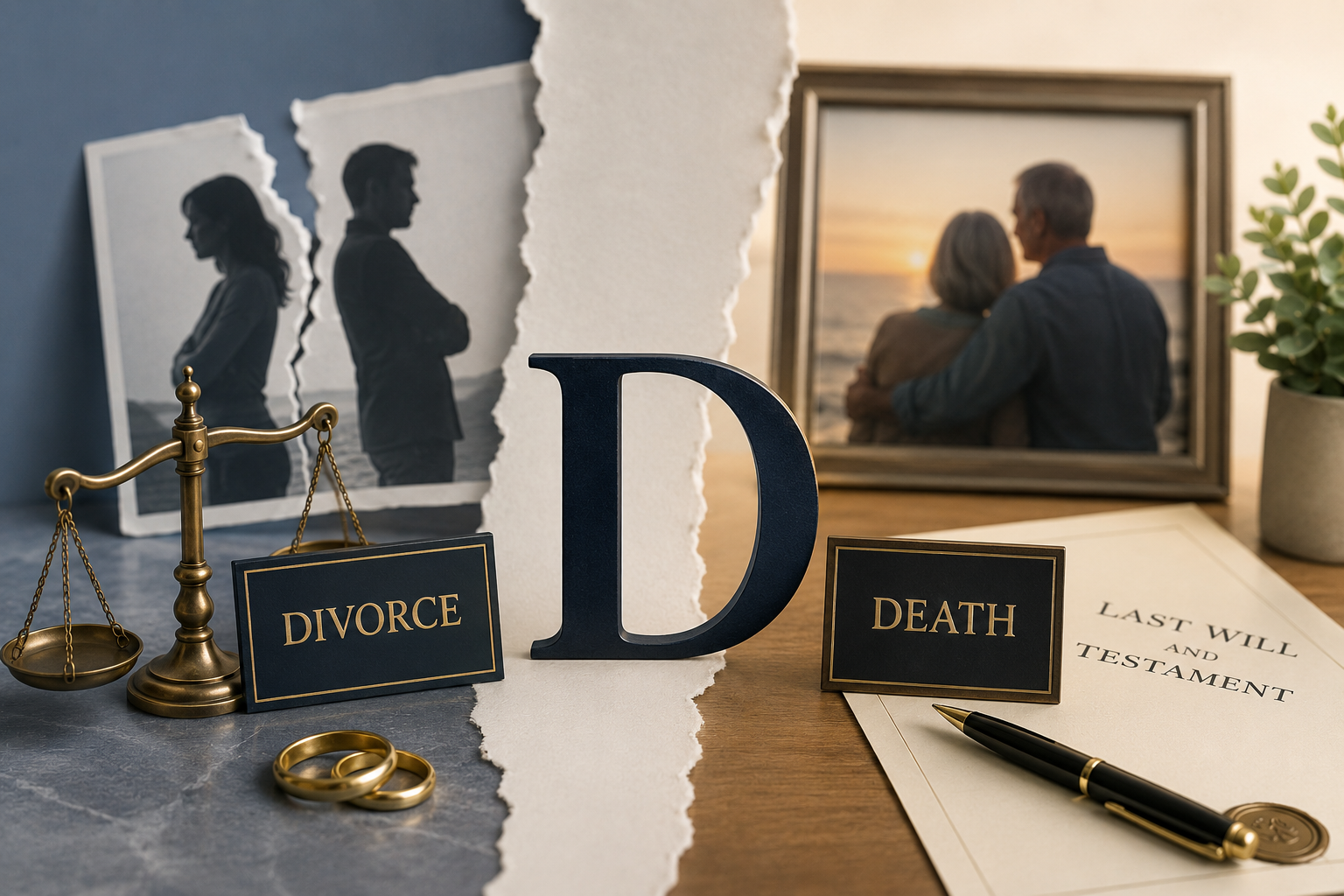
D is for Death and Divorce
Let’s talk about how Virginia treats property when a marriage ends by divorce… versus when it ends by death.
Because the answer is often not what people expect.
Divorce: Equitable Distribution
In divorce, Virginia courts use the doctrine of equitable distribution, governed primarily by Virginia Code § 20-107.3.
The court is asking:
“What is marital property, and how should it be divided fairly?”
That does not necessarily mean 50/50.
It means equitable.
The court looks at:
- marital property
- separate property
- hybrid property
- contributions of each spouse
- length of marriage
- debts and liabilities
- economic and non-economic contributions
- circumstances leading to dissolution
A house owned before marriage may remain separate.
An inheritance may remain separate.
A business started before marriage may remain mostly separate.
But if marital funds or marital effort were added to those assets, the analysis becomes more complicated.
This is a divorce analysis.
It is focused on ownership and fairness between spouses while both are alive.
Death: Elective Share
When one spouse dies, Virginia is no longer asking:
“Who owns what?”
Instead, the law asks:
“Has the surviving spouse received enough of the marital economic partnership?”
That is a very different question.
This is governed by Virginia’s elective share statutes, found in Virginia Code §§ 64.2-308.1 through 64.2-308.15.
The elective share exists to prevent a spouse from being completely disinherited.
In other words:
You generally cannot simply “cut your spouse out.”
Even if your will says so.
Even if most assets pass outside probate.
Even if you “leave everything to the kids.”
Virginia still gives a surviving spouse rights.
The Old Rule vs. The New Rule
Before 2017, Virginia’s elective share was simpler:
- one-third if there were children
- one-half if there were no children
based on the augmented estate.
Now, for deaths occurring on or after January 1, 2017, Virginia uses a much more modern “partnership theory” approach.
Under Virginia Code § 64.2-308.3, the surviving spouse may claim:
50% of the marital-property portion of the augmented estate
—not simply one-third or one-half of probate assets.
That is a huge difference.
What Is the “Augmented Estate”?
This is where many people get surprised.
The augmented estate is much broader than the probate estate.
It can include:
- probate assets
- revocable trust assets
- payable-on-death accounts
- transfer-on-death assets
- certain jointly owned assets
- some beneficiary-designated assets
- certain lifetime transfers
- and even some surviving spouse property in the calculation framework
This means:
“I put everything in my trust”
does not automatically defeat a spouse’s elective share.
Nor does:
“I made my kids beneficiaries”
or
“I added TOD designations.”
Those may avoid probate.
They do not necessarily avoid elective share analysis.
That distinction matters.
A lot.
Example: Divorce vs. Death
Let’s say Husband owned a business before marriage.
In divorce, much of that business might be argued as:
separate property
especially if it was never commingled.
But if Husband dies and leaves everything to children from a prior marriage?
That same business interest may still be relevant to the augmented estate analysis for elective share purposes.
Because death law is not asking:
“Whose was it?”
It is asking:
“What was part of the marital economic partnership?”
That is a very different lens.
And it often surprises families.
Can You Avoid Elective Share?
Sometimes.
But not casually.
The strongest protection is usually:
a valid prenuptial or postnuptial agreement
with a clear waiver of elective share rights.
That is often the cleanest solution in second marriages.
Trying to “out-title” the statute usually creates litigation instead of protection.
A trust alone is usually not enough.
Beneficiary designations alone are usually not enough.
Creative ownership structures often fail.
Clear agreements work better.
Why This Matters in Blended Families
This issue shows up constantly when clients say:
“I want my spouse protected, but ultimately I want everything to go to my children.”
Especially when:
- it is a second marriage
- there are adult children from a prior marriage
- one spouse brought significantly more wealth into the marriage
- there is family business ownership
- there is inherited real estate
Without intentional planning, families often discover these issues after death—when emotions are highest and options are few.
That is not the best time to solve it.
The Better Question
Instead of asking:
“Can I keep my spouse from getting this?”
the better question is:
“What structure creates fairness and clarity for everyone?”
That might be:
- a trust with defined lifetime rights
- a marital trust and family trust structure
- a spousal lifetime access trust
- carefully coordinated beneficiary planning
- a prenup or postnup
- business succession planning
Good planning is rarely about disinheritance.
It is usually about reducing conflict.
Final Thought
Divorce law and death law are not twins.
They are cousins.
Related—but not the same.
And planning based on the wrong one creates expensive surprises.
Especially in Virginia.
If your estate plan involves a second marriage, children from a prior relationship, inherited wealth, or significant separate assets, this is one of the most important conversations to have before there is a crisis.
Because after death, the law gets a vote.
Whether we planned for it or not.
Mary Ellen Bowman is the founder and Principal Estate Planning Attorney of The Bowman Firm, a Northern Virginia based firm focused on providing clear, strategic guidance to help families make confident decisions and avoid costly mistakes.